
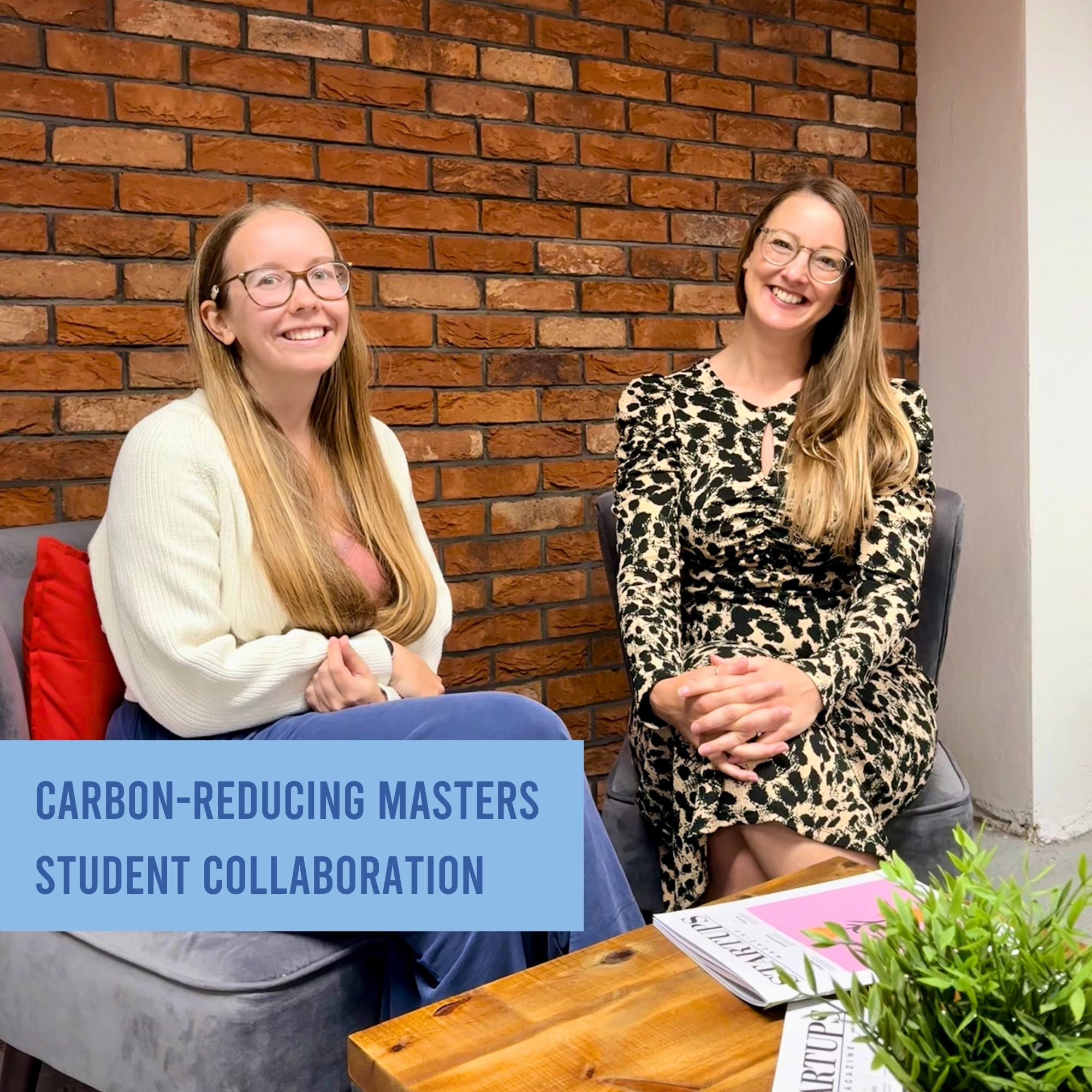
Global City Futures (GCF) is working with the University of Exeter as part of a new collaboration focused on reducing organisational carbon emissions, welcoming Masters student Libby Bruten to the team.
Libby (left) is studying for an MSc in Global Sustainability Solutions at the University of Exeter and is completing a solutions project internship with GCF as part of her degree. During her placement, Libby is producing an updated carbon footprint and a practical Carbon Reduction Action Plan to support GCF in lowering its carbon impact.
Libby’s course brings together sustainability science, policy, economics and systems thinking, with a strong emphasis on applying learning beyond academia. Speaking about her Masters, Libby said:
“We look at sustainability from lots of different angles – the science behind it, policy and economics, but also how you actually make sustainability work in real life. Businesses are a really important part of that.”
Supporting public sector readiness
GCF works extensively with local authorities, the NHS and other public sector organisations, where carbon reporting and reduction planning are becoming increasingly important. Libby’s project focuses on ensuring GCF is well positioned to meet current and future public sector requirements.
“A lot of this is still voluntary for businesses,” Libby explained “but it’s becoming more government- and public-sector driven. If you work with local authorities or the NHS, having a clear carbon reduction plan is going to matter more and more.”
As a consultancy, GCF does not produce physical goods, meaning its emissions profile is different to many organisations. Libby’s work reflects this, focusing on the areas where professional services firms can make the greatest difference.
“For consultancies, things like travel and commuting become much more important. You don’t have a product or end-of-life emissions in the same way, so it’s about understanding where your real impact sits and what changes are realistic.”
Practical action with wider impact
The Carbon Reduction Action Plan will identify tangible, achievable actions that can be embedded within everyday business operations. Libby is also carrying out research alongside the project, exploring how sustainability-focused organisations approach carbon reduction in practice.
“As a lot of research focuses on big businesses with products, I think it’s really interesting to look at organisations that are already working in sustainability and ask what they find difficult and what actually works.”
The project has been designed to be replicable, allowing the approach to be scaled and applied across other small and medium-sized organisations, particularly those working with the public sector.
Working with the University of Exeter
The placement reflects GCF’s commitment to supporting collaboration between academia and practice, helping students apply their learning while strengthening the consultancy’s own expertise.
Rachael Gilliam (right), Senior Consultant at Global City Futures, said:
“Working with the University of Exeter and students like Libby brings real value. It allows us to strengthen our carbon approach using the latest thinking, while also supporting emerging sustainability professionals through meaningful, applied projects.”
Libby’s placement will run through the summer, with the final action plan feeding directly into GCF’s ongoing work to reduce its carbon footprint and continue supporting clients to deliver sustainable, resilient outcomes.